Automatic Roll Handling
Coordinate finished-roll unloading, shaft extraction, orientation and transfer around a slitting or rewinding line.
- Finished-roll unloading
- Shaft and core interface review
- Transfer to staging or downstream handling
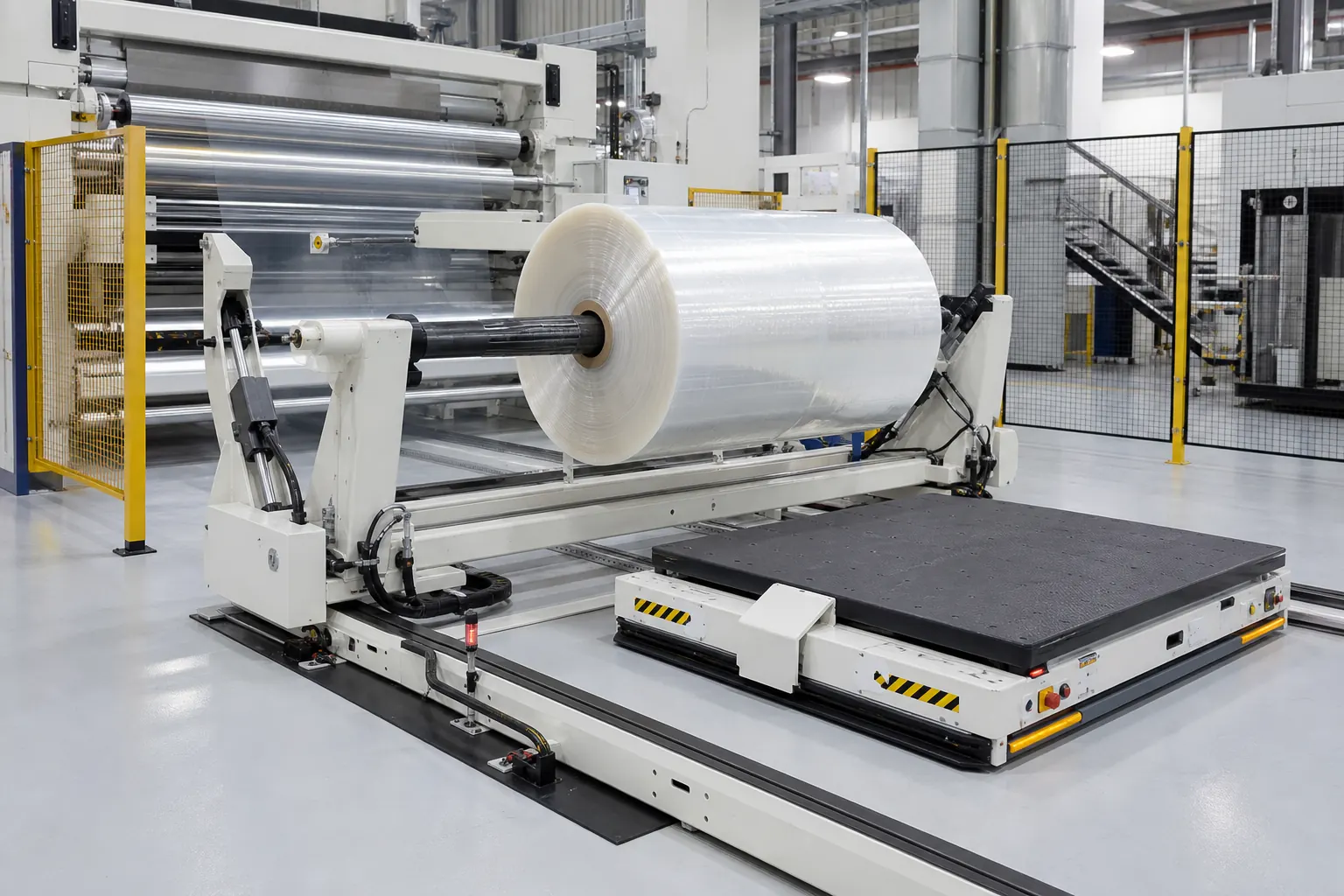
Move heavy finished rolls with a defined support and transfer sequence
Automatic roll handling is not a single catalogue module. The unloading method must match the rewinder, shaft or core arrangement, roll surface sensitivity, destination and plant safety strategy.
SlitForge organizes the operating requirements and coordinates the review with the relevant equipment supplier. Final drawings, component responsibility and acceptance criteria are confirmed in the formal proposal.
- Starting point
- Finished roll supported at the rewinding station
- Handling path
- Unload, stabilize, extract or retain the shaft, then transfer
- Confirmation basis
- Roll geometry, weight, route, interface and safety review
Four interfaces define the handling workflow
The exact mechanism may use a powered cradle, trolley, turntable or another engineered handoff. The sequence below is the review framework, not a fixed machine specification.
Release
The rewinder stops in a controlled position and the handling sequence is interlocked with the line.
Receive
A supported cradle or lifting device stabilizes the roll before shaft release or transfer begins.
Reorient
The roll may remain horizontal or be rotated when the downstream packing and storage workflow requires it.
Transfer
The roll is delivered to a defined staging, inspection, wrapping or material-transport interface.
Modules are selected around the real production route
- Powered receiving cradle or lift table
- Rewind shaft extraction or shaft-retaining transfer
- Horizontal transfer cart or floor-rail system
- Roll rotation or turntable where orientation must change
- Guarding, presence sensing and sequence interlocks
- Optional weighing or identification interface when required
Responsibility and acceptance points stay visible
Mechanical interface
Mounting, shaft or core engagement, transfer elevation and available clearances are documented.
Controls and safety
PLC signals, interlocks, guarding concept and operator access are reviewed with the responsible supplier.
Acceptance criteria
Handling sequence, test material, responsibility boundaries and site conditions are written into the proposal.
Review the machine interface before defining automation
Share the roll geometry and required destination
We will organize the handling sequence and coordinate a supplier-confirmed technical review.